Is an algorithm driving your social media, or is it the branded hashtag?
Once upon a time, hashtags were the golden ticket. More hashtags = more reach. Whether you were a school posting about enrollment or a small business announcing a sale, the playbook was simple: load up 20+ tags and watch the visibility roll in.
Fast-forward to 2026, and things look very different. Algorithms are smarter. Feeds are more personalized. And hashtags—especially branded ones—aren’t the discovery powerhouses they used to be.
So, have hashtags really gone extinct? Not quite. They’re still useful, but their role has shifted from driver to supporting act. Let’s break down what that means for schools and small businesses.
1. A Quick History of the Hashtag
- Origins: Hashtags started on Twitter back in 2007 as a way to group conversations.
- Explosion: Instagram embraced hashtags early; the platform let you use up to 30 per post, and more tags often meant more reach.
- Why it worked: Hashtags were once the main way users searched for new content. Think: prospective families searching #STEMeducation or shoppers browsing #LocalCoffee.
But as platforms got better at reading content and predicting user interests, hashtags became less central. Algorithms started prioritizing relevance, engagement, and quality over raw keyword tagging.
2. Instagram: From Hashtag Overload to Algorithmic Discovery
Instagram used to be the hashtag playground. Ten years ago, a local boutique could post a photo with #fashion, #style, #outfit, and instantly attract strangers. Schools leaned on tags like #FutureGrad or #GoEagles to fuel awareness.
What’s Different Now
-
- In late 2024, Instagram removed the option to follow hashtags, a clear sign the platform is downplaying their role (Social Media Today).
- Instagram leadership has confirmed that hashtags no longer significantly increase reach (Postly).
- The algorithm now prioritizes quality content, engagement, and keywords in captions over hashtag clouds.
What This Means
For schools: Focus on authentic stories. A post about a robotics team win will travel farther if parents and students comment or share than if you tack on 15 hashtags.
For small businesses: A beautifully shot product photo with a clear caption (“Hand-poured soy candles, now in stock at our downtown shop”) will beat a hashtag dump every time.
Use hashtags sparingly—3 to 5 targeted ones like #STEMcamp, #CollegePrep, #ShopLocal, or #HandmadeCandles—to aid search. But let the content do the heavy lifting.
3. Facebook: Hashtags Never Took Off
Facebook never really became a hub for hashtags. Most people scroll for posts from friends, groups, or pages they follow—not hashtags.
Research has shown that posts without hashtags often perform better than those with them (Social Media Today). The algorithm favors content that sparks comments, shares, and reactions.
What This Means
For schools: A post announcing kindergarten roundup will spread if parents tag their friends or share it—not because you added #Kindergarten.
For small businesses: A café’s new latte flavor will get reach if customers comment (“Can’t wait to try this!”) or share, not because you tagged it #PumpkinSpice.
That said, hashtags can still help organize content around specific campaigns. Example: #RiversideOpenHouse2026 for a school event, or #ShopDowntownWeek for a business promotion. Just don’t rely on them for reach.
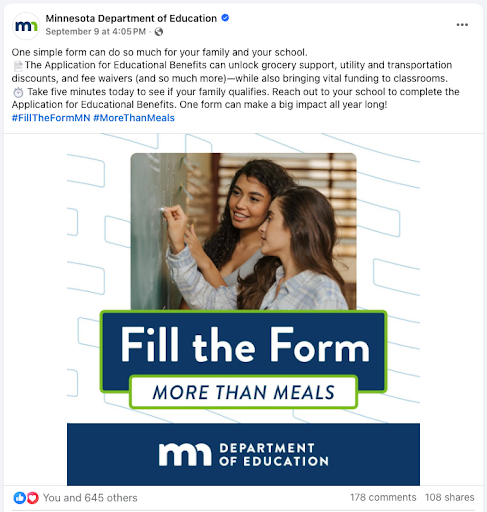
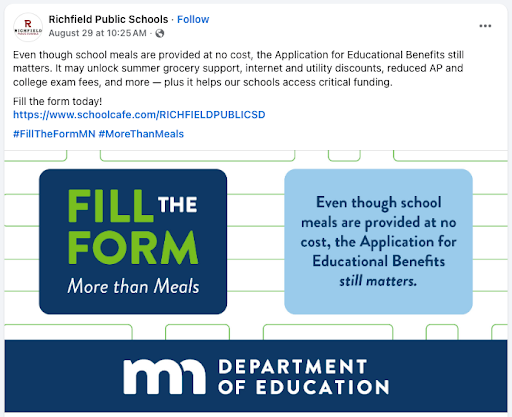
“What’s overlooked is the internal value of a hashtag. On a campaign like #FillTheFormMN, school comms teams could track how other districts were framing the same message. It wasn’t just about parents seeing the tag—it was about communicators learning from each other in real time.”
– Andrew A. Hagen, Integrated Communications Coordinator at CEL
And there are moments when hashtags add value on Facebook: The Minnesota Department of Education’s recent “Fill the Form” campaign used #FillTheFormMN and #MoreThanMeals consistently. Families could click the hashtag to see how other districts and organizations were sharing the message, creating a sense of momentum and credibility. That’s a great illustration of hashtags working as a community-building tool rather than a reach booster.
4. LinkedIn: Still Useful (With Limits)
LinkedIn is the one place where hashtags still play a significant role, particularly in recruitment and professional networking. Users follow hashtags like #HigherEdJobs or #SmallBusinessGrowth, and content with those tags can reach people outside your network.
However, even LinkedIn acknowledges that hashtags are a supporting signal, not a reach booster. As one LinkedIn strategist notes: “The algorithm prioritizes content relevancy, quality, and engagement over metadata such as hashtags.” (LinkedIn Pulse)
Best Practices
-
- Stick to 3–5 hashtags per post. Overstuffing looks spammy.
- Use a mix of broad and niche tags: #Hiring + #FacultyJobs, or #Entrepreneurship + #ShopLocal.
- For schools: Tag faculty openings or alumni success stories.
- For small businesses: Tag posts about growth, leadership, or industry-specific communities.
“Hashtags are also a signal of credibility. On LinkedIn, seeing #FacultyJobs or #ShopLocal tells the reader: this post belongs in a bigger professional conversation. It’s less about gaming the algorithm and more about signaling you’re part of that dialogue.”
– Ashley Winter, Content Marketing Coordinator
5. Algorithms vs. Hashtags: The Reality
| Then |
Now |
| Hashtags = discovery (search, trending) |
Algorithms = discovery (personalized feeds, recommendations) |
| More hashtags = more reach |
More engagement = more reach |
| Branded hashtags = community + visibility |
Branded hashtags = community only (visibility depends on engagement) |
In short, algorithms decide what travels. Hashtags help categorize your post, but they won’t rescue weak content.
6. What This Means for Schools and Small Businesses
So, Are Hashtags Extinct?
No. But they’re not the star of the show anymore. The algorithm is.
For schools and small businesses alike, the best strategy in 2026 is simple:
-
- Create engaging, relevant content first.
- Use hashtags to support, not lead.
- Think of them as signposts, not megaphones.
Hashtags may not be flying high anymore, but they’re far from dodo birds—just evolved.