


Building Community Partnerships That Solve Real Problems
Once upon a time, you gave $10 to the charity with a table out front of the grocery store. That was nice of you. Thank you. Now you're on their twice-weekly email plea for more donations.
Maybe you’d like to help again. Maybe another donation is exactly how you’d prefer to do it. Or maybe you’d enjoy organizing a community shelf, writing a letter to legislators, or sharing a professional skill. But every email offers the same option: give more money.
Organizations need financial support. They also need ways to learn how people want to participate, then put that information to use. That starts with offering clear choices and continues with making the next invitation relevant to the person receiving it.
What the Ask Sounds Like When It's Built Around Guilt
Sitting on the table at the coffee shop you stop at every morning for your Americano is a flyer from the local elementary school PTA:
- $25 — I'm not baking anything. This covers what the cupcakes would've cost, plus my dignity.
- $35 — I'm not knocking on doors selling popcorn tins to people who already avoid me at pickup. Consider this your commission for letting me skip it.
- $50 — Every flier you send home is going straight into my recycling bin unread. This is my way of feeling okay about that.
- $75 — Between work, kids, and everything else, I have exactly zero hours to give this year. This buys those hours back.
- $100 — Let's be honest, I was never showing up to the meeting anyway. This makes us both feel better about it.
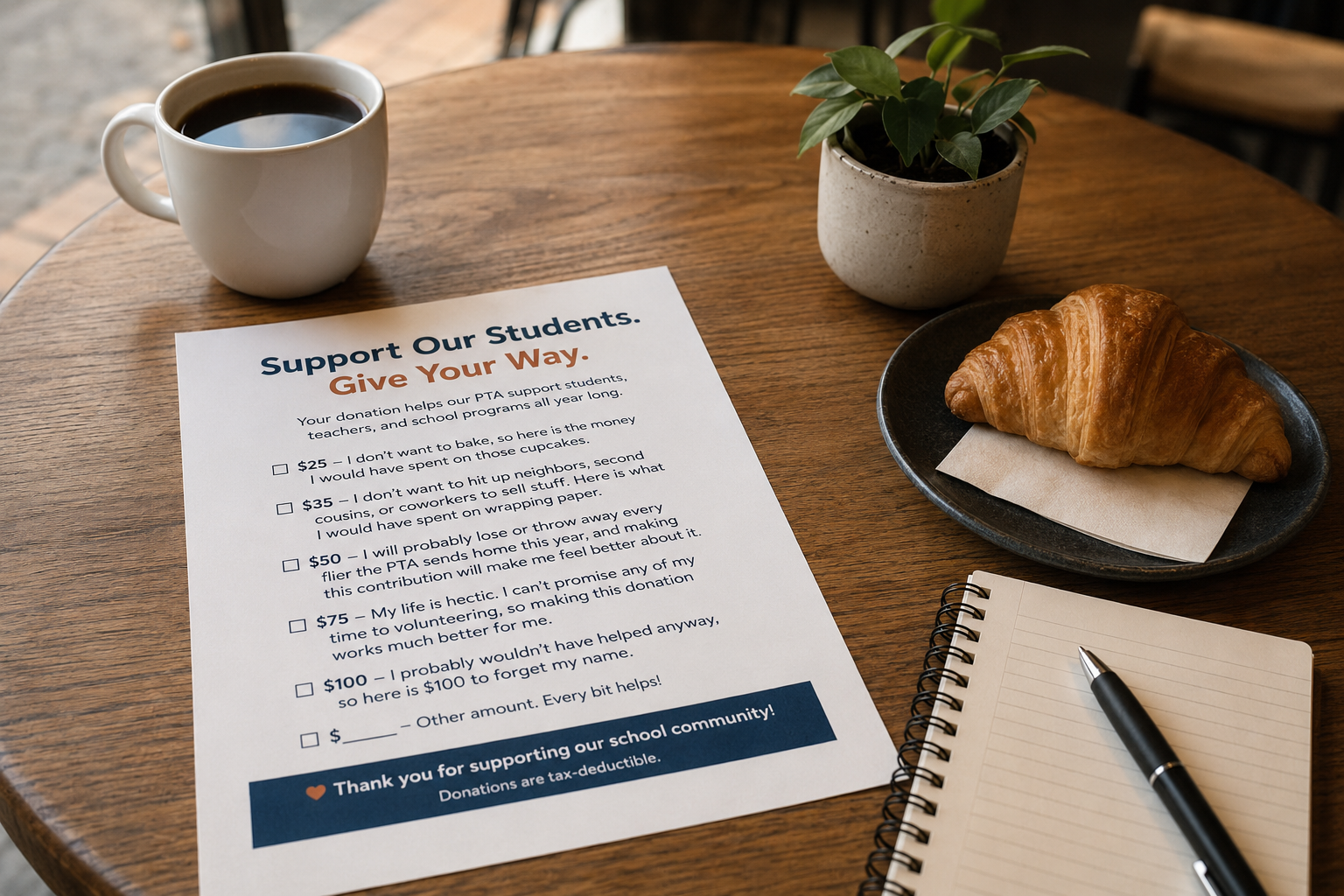
It's clever. It'll go viral on Instagram. It's also an accident of honesty. Read enough of these, whether it's a school flyer, a donor page, or a chamber sponsorship packet, and the pattern repeats: organizations assuming nobody really wants to give, and price the guilt accordingly.
But going viral isn't the goal. Building community is.
What the ask sounds like when it's built around intent
Take a look at how some other nonprofits in your community structure their websites. Many of them have moved past separate pages for donating, volunteering, advocating, and corporate giving, and now lead with an à la carte menu of options for supporting them:
- Donate now
- Volunteer
- Advocate
- Corporate partnerships and mentorships
- Give items — new or gently used
- Join the email list
- Attend an event
- Help from home, on your own time
That last option matters as much as any other. Plenty of people can write a letter, review a document, leave a few voicemails for legislators, or assemble something at their kitchen table on a Tuesday night. Naming that option outright tells people that however they show up, from a desk or a couch or a front door, counts the same.
The menu isn't the innovation. The order is. Start with what the visitor wants to do, not which department will process the request, and not how many times they can be asked for another $10 before they unsubscribe.
The $10 is enough. And for some, there's more.
A parent juggling three kids' schedules isn't carrying more than a young professional managing a chronic health condition. A retiree with a part-time job isn't sitting on free time waiting for an email plea. Plenty of people who gave $10 outside the grocery store gave what they had. And all of these community members want, in equal measure, to build a stronger neighborhood.
But for the person whose $10 wasn't a stretch, whose capacity includes something beyond a wallet, the ask should make room for that too. Accountants, electricians, translators, legislative aides drop $10 in that bucket too, and a second $10 ask undersells what they could actually offer. Maybe the most valuable ask isn't another donation. It's, "We know you're in marketing. Could we call you a few times a year when we need another set of eyes on something?" Or, "We know you're an electrician. Would you mind taking a quick look before we call a contractor?" Those asks don't replace the $10. They reveal everything the $10 never could. The organizations doing this well aren't assuming everyone has more to give. They're building a menu wide enough that whoever does can find where it fits, without implying the person who doesn't gave anything less.
Build a list of people who already said yes
A menu with eight doors is only as useful as what happens after someone walks through one. Most organizations collect the name and let it sit until the next campaign needs bodies. Keep a running list instead, so the next need doesn't start from zero.
Think of it less as a donor database and more as a standing roster. The retiree who wrote one letter goes on as someone willing to write again. The business that hosted a shelf-stocking afternoon goes on as a business open to another one, quarterly or annually, no cold pitch required.
Keep the door open, not closed, and certainly not locked.

A local business offering a team bonding day isn't asking for a gala sponsorship. They want a few hours, a clear task, and a story their team can tell each other afterward. Treat that right, and it becomes a repeatable relationship instead of a one-off. But don’t forget about the student group looking for service hours who can help you set up, guide guests to their seats, and take down from that gala.
Reach the list instead of broadcasting to everyone
The roster isn't just for the next time you need ten volunteers on a Saturday morning. It's also for everything in between.
The mentor who volunteered last year gets an email in August: same mentee, a new match, or a year off, no explanation needed. The family who donated last fall gets a thank-you in October that isn't attached to another ask at all, just a few examples of what their gift accomplished. The business that hosted a team volunteer day gets a note in the spring asking whether they'd like to do it again.
When a specific need comes up, the roster already knows where to start. Need five interview volunteers Thursday? Message the dozen who've done it before. Need a picnic table repaired? Call the contractor who fixed the fence last spring. Need a Saturday crew? Reach out to the business that asked whether another team-building day was available.
None of this requires software you don't already have. It requires deciding that "mentor," "volunteer," "contractor," and "donor" aren't just rows in a spreadsheet. They're people who've already told you how they'd like to help. Keep talking to them that way, and the next ask feels less like another campaign and more like an invitation they were already expecting.
Respect the ‘yes’ you already got
You’ve probably noticed that two threads are running through this blog:
-
Every organization has neighbors it has never really met. The apartment complex down the street. The business that would love a team-building day. The retiree who'd write another letter if someone remembered to ask. They recognize you. That's not the same as knowing you. The roster closes that gap, one specific ask at a time.
-
Once someone tells you how they want to help, that's the invitation, not the starting point. The retiree who wrote letters gets asked to write more letters, not work a Saturday shift. The family who dropped off a box of toothpaste gets asked for another crate, not a recurring donation. Matching the next ask to what someone already offered is its own form of respect. It tells them you were listening.
Both threads come from the same place: refusing to ask for more than what's being offered freely. That's the difference between a partnership that was built and one that was only ever managed. A managed relationship keeps testing how far it can push. A built one keeps its word about what it asked for in the first place.
You don't put a house guest in your annual report, and you don't ask them to start doing the dishes because they were kind enough to bring wine. You make them comfortable, remember what they like, and let them keep showing up exactly the way that works for them.
Published on: October 1, 2026